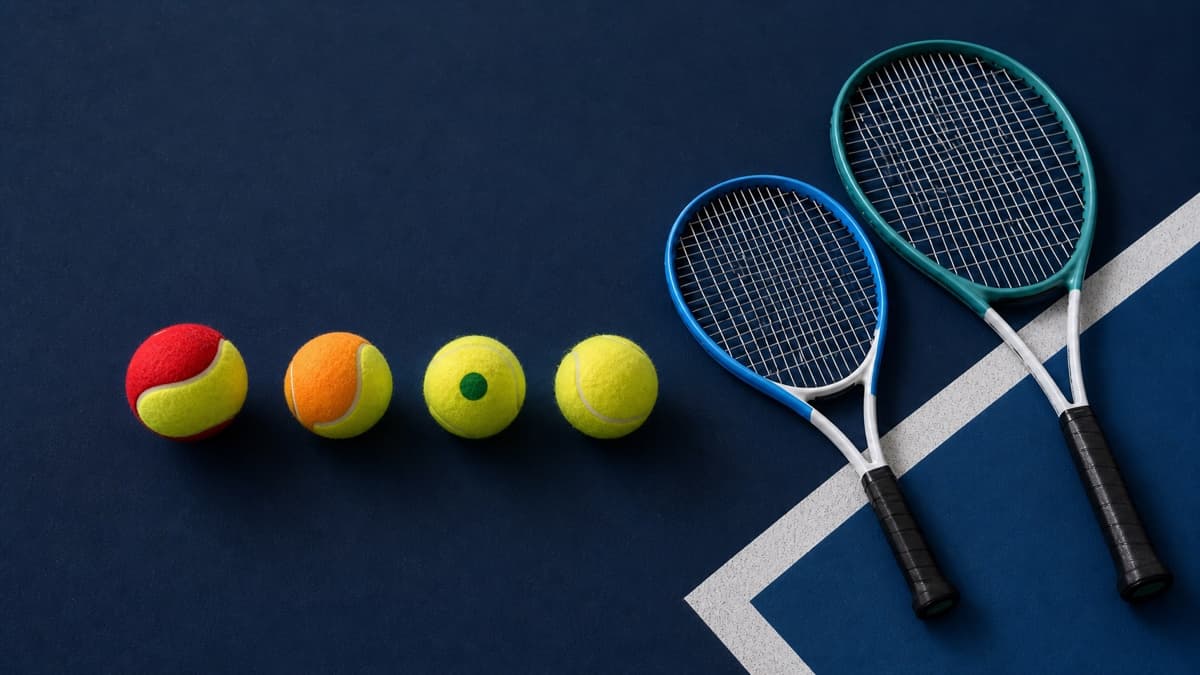
Understand what changes at each stage
Slower balls and scaled courts give players more time and a reachable playing area. As the stage changes, the ball generally travels faster and the court demands more movement.
Local programmes and competitions may apply their own pathway rules. Confirm the actual ball, court and scoring format rather than relying on a colour label alone.
- Red: the slowest ball, usually paired with a short court for learning to start, rally and score.
- Orange: a faster ball and larger reduced court, adding more movement while preserving preparation time.
- Green: a slower-than-yellow ball on a full-size court, supporting the transition to full-court play.
- Yellow: the standard ball on a full-size court, useful when the player can do more than react and survive.
Judge the stage by the game your child can play
Watch several sessions, not one good rally. A suitable stage allows the child to attempt the skills being taught without most points ending because the ball or court is unmanageable.
Look for preparation and control, the ability to start points and sustain some rallies, court coverage and recovery, simple choices and a continued willingness to play. These signs matter more than power, a friend’s stage or the desire to move up quickly.
Change stage with a clear reason
Moving up should create the next useful challenge while leaving enough success for learning. Ask what new skill or playing demand the change is meant to develop.
If the new ball or court repeatedly makes contact late or off-balance, shortens nearly every rally or prevents the child from using the intended skill, the coach may keep more work at the current stage. Players can also use different balls for different tasks. Returning to a slower ball is an adjustment, not a demotion.
Put it into practice
What parents can do
- Confirm the ball, court and scoring format used in regular training.
- Ask what the current stage is helping your child learn.
- Watch rallying, movement and decisions across several sessions.
- Treat stage changes as coaching decisions, not status changes.
Choose the right next step
Who to contact—and what to say
- Coach: “Which ball and court does my child use most, and what is that stage teaching them?”
- Coach: “What would show that they are ready to spend more time at the next stage?”
- Organiser: “Which ball, court size and scoring format will this event use, and does that match my child’s current training?”
Evidence basis
Sources used for this guide
Last editorial update 25 July 2026
Share this guide with another parent